
In today's rapidly evolving digital payment landscape, security concerns remain a top priority for stakeholders across sectors.

Loans, cash credits, and overdrafts at the end of December 22, 2017, stood at Rs 81,287.32 billion, against Rs 73,340 billion in the year-ago period.

Indian growth in the rest of this fiscal year and next will be propelled by robust domestic consumption as consumer confidence improves, and by investment, including large increases in government capital expenditure, according to the Asian Development Outlook September 2023. "As slowing exports could foment headwinds for the economy, and erratic rainfall patterns are likely to undermine agricultural output, the growth forecast for FY2023 is revised down marginally to 6.3 per cent," ADB said.

Bankers, who met the Reserve Bank of India Governor D Subbarao on Monday, two weeks before the annual monetary policy scheduled for April 20, said none of them was presently contemplating hike in lending rates given the 'reasonable' liquidity in the system.

'We have to retain some fiscal headroom without compromising on the promised fiscal consolidation roadmap.'

The affordable housing segment may be seeing an uptick which is a good sign of consumption momentum. This is the biggest-ticket purchase for middle income and lower income families. The current activity is at least partly driven by a pause in interest rate hikes.

Cholamandalam Investment and Finance's (Chola) share has yielded one of the best returns in the last month. The company has sustained assets under management (AUM) growth at 7 per cent quarter-on-quarter (Q-o-Q), and 35 per cent year-on-year (Y-o-Y) in Q1FY25. Scaling up of new businesses now contributes to 13 per cent of loans (vs 10 per cent in Q1FY24).

'Additionally, the significant employment multiplier will boost direct and indirect jobs of up to 1.1 million.'

If growth reverts to the pre-Covid level, a lot of people may have to temper their rosy optimism, points out Debashis Basu.

These core industries comprise 40.27 per cent of the weight of items included in the Index of Industrial Production.

Credit card spending has hit a record high of Rs 1.4 lakh crore in May, the latest data from Reserver Bank of India showed. The total spending or outstanding dues on credit cards, which remained rang-bound throughout the year in the previous fiscal, have been rising by 5 per cent month on month this year. Similarly, the number of cards in use has also jumped by more than 5 million since January and crossed 87.4 million in the reporting month, making this also an all-time high in May, according to the RBI data.

Should deposit growth continue to outpace credit growth, banks may end up ceding some hard-earned 25-50 bps improvement in profitability or net interest margin gained in the past two years.
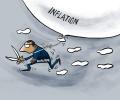
Most members of the Reserve Bank of India's monetary policy committee (MPC) decided to stick to the course on bringing retail inflation to the target of 4 per cent while voting for maintaining status quo in the April review, except external member Jayanth Varma who voted for a 25 bps cut in the repo rate. "I believe that the extant monetary policy setting is well positioned," RBI governor Shaktikanta Das said in the minutes of the policy review, which came out on Friday. "Monetary policy transmission is continuing and inflation expectations of households are also getting further anchored.

It will be the second Budget of the Modi 3.0 government and eighth straight Budget for Nirmala Sitharaman, rare in Indian polity.

While GBP 50 million is earmarked for grassroots and recreational cricket, the 18 English county teams will get a share of GBP 470 million with larger pie allocated for those clubs that don't own a 'Hundred Franchise'.

While rising interest rates and tighter liquidity are giving negative signals for the financial sector, increasing economic activity could mean higher business volumes for lenders. Liquidity in the banking system has moved from Rs 8 trillion surplus into a deficit of Rs 33,000 crore over the 2022 calendar year. By the end of November, bank credit had grown 17.5 per cent YoY (year-on-year).

'What I hope to do is provide a vehicle for that scale and growth in literacy and English as a second language here.'


Hailed as the architect of India's economic reforms, former prime minister Manmohan Singh in one his last interviews had said in 2019 that the country's economy was 'over-regulated', the government exerted control and interferences were aplenty with even regulators having 'morphed into controllers'.

India's credit and banking are neither too big nor too small.

As the Union Budget 2025-2026 (FY26) inches closer, the Indian real estate industry is seeking stamp duty cuts, revised home loan limits and updated affordable housing norms through Pradhan Mantri Awas Yojna (PMAY), single-window clearance and eco-friendly policies, among others. Industry leaders and consultancy firms, including Anarock, Raheja, Gaurs, Kanodia Group, Reach, Urban Space, Justo and Eros Group, have shared their expectations.

Investors should view any bounce-back in bank stocks as an opportunity to exit the pack, analysts suggested, as the worst may not be over yet. The recent quarterly results of HDFC Bank and Axis Bank disappointed the Street, triggering a marketwide selloff by foreign institutional investors, especially in banking counters. While HDFC Bank, which was the anchor for the market correction during the past week, ended 2 per cent higher amid short covering on Wednesday, Axis Bank's shares settled 3 per cent lower.

'.. if you do not want to take the asset allocation call.'' 'This category of funds can offer optimum risk-adjusted returns.'

From the 30-share pack, Adani Port, Bharti Airtel, Asian Paints, IndusInd Bank, Bajaj Finserv, Reliance Industries, Infosys, UltraTech Cement, HDFC Bank, HCL Technologies and ICICI Bank were among the laggards. Tata Motors, Axis Bank, Maruti, Larsen & Toubro, ITC and Tata Steel were among the gainers.

'The stabilisation of interest rates followed by reduction is going to happen over the next year.'

Roughly 40% of this projected outlay is expected to go towards emerging industries, including green hydrogen, clean energy, semiconductors, and electric vehicles.

India's economy will see the fastest dollar nominal growth in the world in 2015, Credit Suisse says.

The RBI has changed the way it approached supervision in the past. Having seen a couple of collapses in the NBFC sector and the near-collapse of a few banks, it is focusing on regular drills to prevent a fire from breaking out, explains Tamal Bandyopadhyay.

Will allowing business correspondents to hawk insurance products help in reviving 5-lakh strong field agents as a viable channel?

'The dakiyas will be our partners, receiving credit proposals from micro-enterprises at the grassroots level.'

'We have a plan to plough back a 'This year in the first half we had profits of more than Rs 31,000 crore.' significant amount of profits this financial year.' 'We have seen this organic plough back of profit is one of best ways to support the equity of the bank.'
The credit growth in the current financial year has slowed down to 22.6 per cent at the end of January 2007 compared with nearly 30 per cent a year ago. While that in itself is not too worrying, most of the demand stems from companies with retail offtake in low double digits.

'During his stint as prime minister, he got 270 million people out of poverty.' 'This, according to the World Bank, is the fastest compression of poverty anywhere in the world.' Arvind Mayaram, the former finance secretary, recalls his encounters with Dr Manmohan Singh.

We knew it was difficult to get Ishan back from auction due to his skill set: Hardik Pandya

10 largecaps stocks which stand to gain from the Budget.

Fitch Ratings on Thursday raised its forecast for India's economic growth to 6.3 per cent for current fiscal year 2023-24 from 6 per cent it had predicted previously. This is primarily because of a stronger outturn in the first quarter and near-term momentum. The growth forecast compares with 7.2 per cent GDP expansion in FY23. In the previous fiscal year (FY22), the economy had grown 9.1 per cent.
Thanks to a resource bind, at least principally, credit moderation has begun.

The asset quality of microfinance portfolios worsened in the quarter ending June 2024 due to the impact of heatwaves on borrowers' incomes and collections, coupled with rumours of loan waivers, according to Sa-Dhan. Jiji Mammen, executive director and chief executive officer of Sa-Dhan, said loans with 90+ days past due (dpd) rose to 1.2 per cent in June 2024, compared to 0.9 per cent in June 2023. The 90+ dpd also increased from 1.16 per cent in March 2024.

Domestic rating agency Icra on Monday upped its banking sector outlook to 'positive' on healthy asset growth, improving asset quality and stronger capital buffers. The agency expects asset quality to improve to a decadal best of 4 per cent from a gross non-performing assets (NPAs) perspective by the end of FY24. The banking system's credit growth will slow down to 11-11.6 per cent in FY24, after a very healthy growth of 15.2-16.1 per cent expected in FY23, the rating agency said.
